
The Ghurka
Bags to be handed to the next generation since 1975

You are in the back of a Willys Jeep. Door rattling. Dust in your hair. The Zambezi river is somewhere to your left. You are heading towards G Camp, and there is very little space.
A case of Castle Lager. A gun bag with a .375 H&H. A cooler box. And a bag. Not something with wheels and a retractable handle. A bag made from canvas and leather that has spent years earning its own particular slouch. Worn at the corners. Darkened at the handles. Smelling faintly of somewhere (and maybe a bit of Castle Lager).
Somewhere in the back of your mind is the thought that if you look after this thing (or more accurately, if this thing looks after itself) there is a reasonable chance your children might one day argue over it.
Ghurka has been building bags to be handed to the next generation since 1975.
The Gurkhas


The Brigade of Gurkhas are Nepalese soldiers serving in the British Army. They are among the most decorated units in the British Army.
Marley Hodgson and his wife Linda were in England. There was an auction at the home of a senior British officer / Gurkha commander whose service had taken him to India. At the sale, Hodgson encountered a collection of leather goods (which included boots, belts, and backpacks) nearly 100 years old, yet the leather remained supple, sturdy, and full of character
“I just was struck by the condition. How this leather held up over all this time.”
He obtained the original tanning formula. By his own description: jungle proof, rot proof, desert proof.
He brought the formula back to America. He and Linda founded Ghurka in 1975, named for the soldiers whose gear had stopped him at that auction, with a spelling adapted from the original. The first piece was the No. 1. A leather knapsack made for Hodgson’s son, never in commercial production. But the response at his prep school created sufficient demand that the second bag, the Express No. 2, became the opening line of what would eventually become a numbered catalogue running into the hundreds.
In time, Ghurka was included in a book called Quintessence. A survey of iconic objects, not merely expensive ones. It placed them alongside Mont Blanc pens and the martini. Hodgson notes this with a kind of quiet satisfaction. They were not chosen because they were luxury. They were chosen because they were iconic. The distinction mattered to him.
It still does.
What Made It Different
The thesis was simple, which is why it held.
Ghurka made bags for people who did not want to think about replacing their bags. Not in the sense of careless, in the sense of permanence. You bought one. You used it. It got better. You kept using it. Eventually it belonged to someone else.
The construction was specific in ways that mattered. French calf leather dyed as aniline to preserve surface character. Edges painted by hand in multiple passes. Internal standards for binding thickness and stitch density. Long-running Connecticut workshops where the original collection was made from the beginning.
Each bag carries a registration number that allows it to be dated to the exact year. The alphanumeric code corresponded to a real system, with leading letters mapped to production year codes tracked from 1978 through 2024. If you find a vintage Ghurka, you can date it.
The numbered design system gave the line coherence without homogeneity. Every bag had a personality and a function. All of them shared a grammar: generous pocketing, rounded silhouettes, brass closures, leather-and-canvas construction that rewarded use rather than punishing it.
Standing the test of time

After September 11, Hodgson chose to exit. The brand passed through a series of owners, each of whom tried (with varying degrees of confidence) to modernise it.
Racing stripes appeared. Handbag collections emerged. Manufacturing moved to Asia. The people who had loved the original product began hunting vintage Ghurkas on eBay and through specialists like Best of Marley, paying premiums for what they called the Marley Hodgson era (roughly 1975 to 2003).
The brand entered Chapter 11 in 2018. It was acquired in 2019 by a Cleveland-based investment group and methodically began the work of putting it back together.
Creative director John Truex, co-founder of Lambertson Truex, which produced some of the defining bags of the early 2000s, was brought in. He went to the archives. He pulled original patterns. He updated proportions for contemporary carry. Laptop sleeves, phone pockets. He did not reinvent the language; he cleaned it up.
Production was reshored. Core bags are now made in the United States. When Truex says that if Marley Hodgson saw the new No. 2 he would go “Oh, that’s the Express”.
The bags nearly disappeared. They did not.
Three Pieces Worth Knowing
The Express No. 2
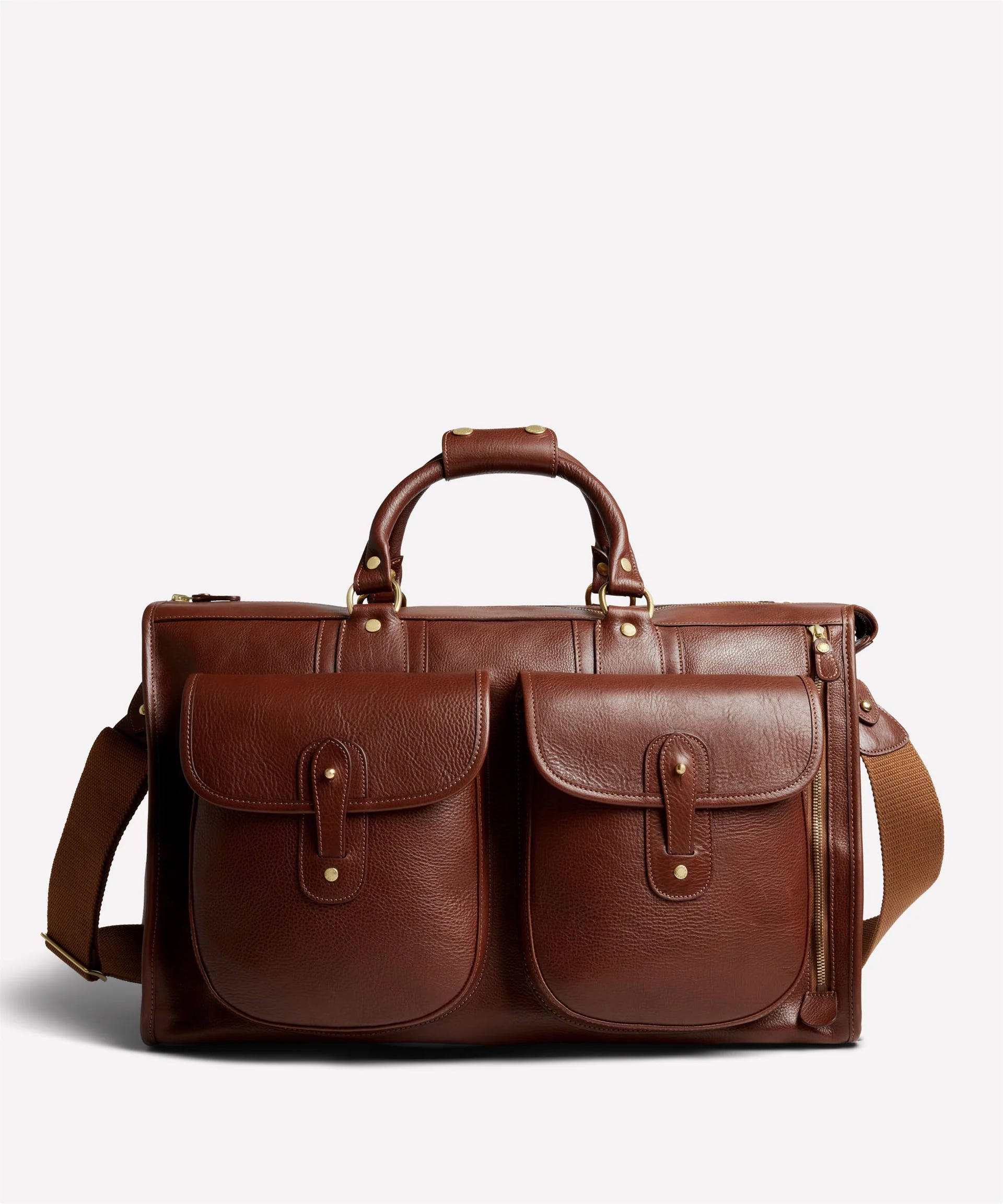
If you are going to own one Ghurka, the No. 2 is the argument for owning it.
A weekender. Medium duffel. Multiple exterior flapped pockets. The brand signature. Detachable shoulder strap. Interior large enough to function as a real carry-on without the theatrical proportions of a bag that has forgotten what air travel involves.
Hodgson built it as a weekend bag. It still works as one fifty years later.
The Examiner No. 5
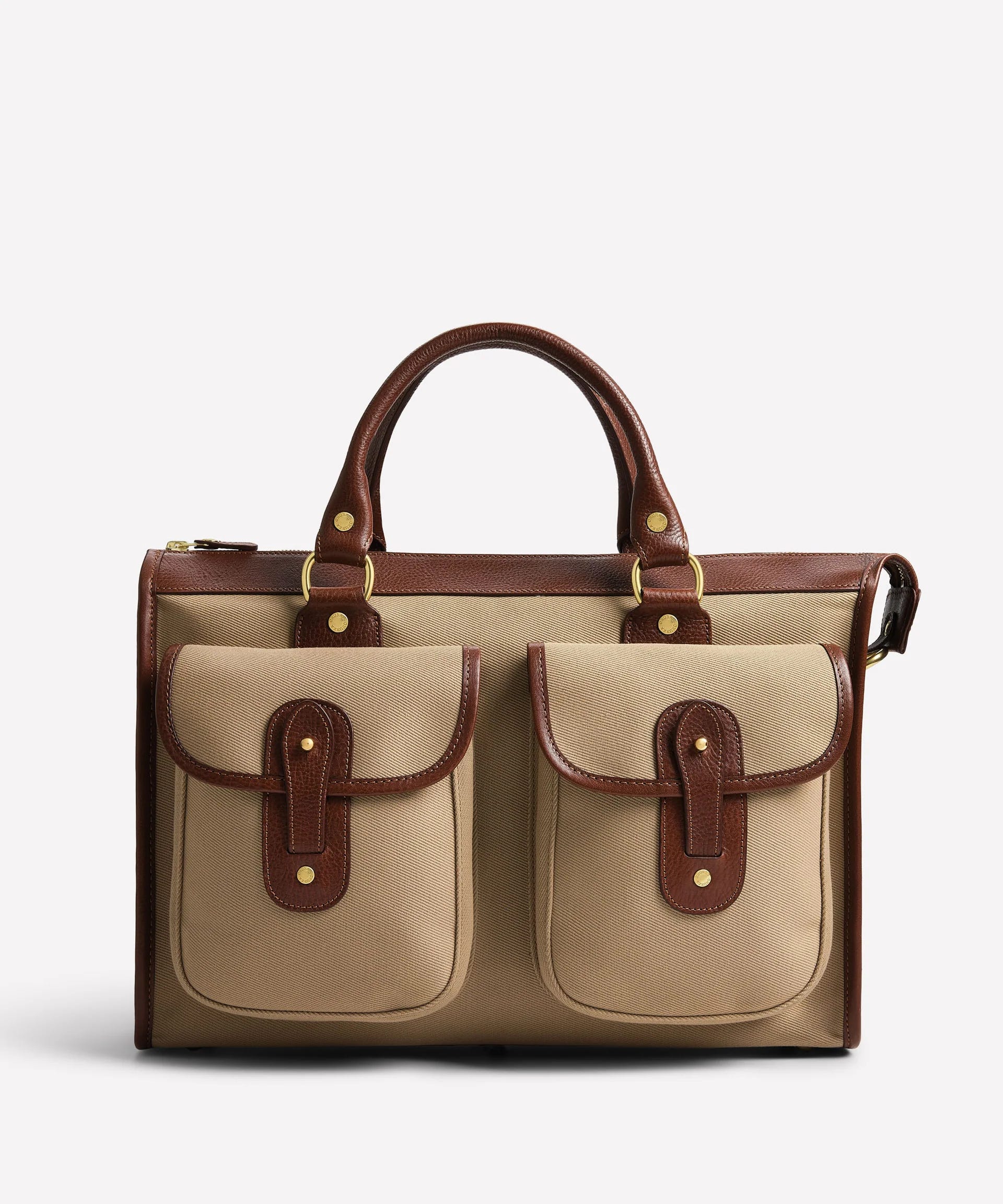
Classic briefcase silhouette. Exterior pockets. Interior organisation. The shape that was ubiquitous in a certain kind of 1980s Manhattan morning.
Most briefcases of this type have become either nostalgic props or corporate uniforms. The Examiner avoids both because it was never about performing professionalism. It was about function dressed in good leather.
The structure holds shape. The leather moves with you. The pockets know what they are for.
Market Tote No. 294
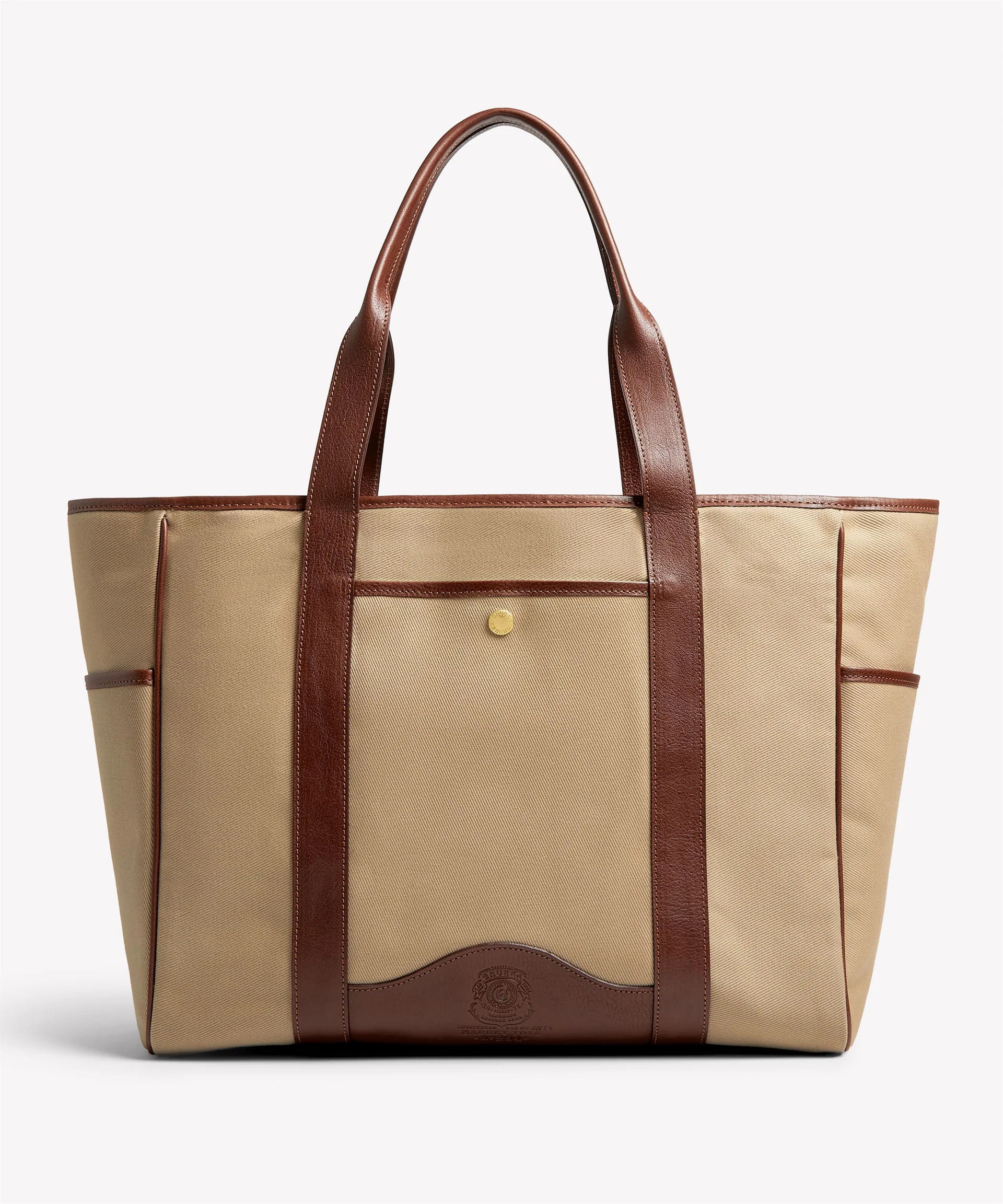
An open-top tote, which sounds like a liability and is not.
Khaki twill body. Vintage chestnut leather handles and trim. No closures to overthink. No structure to maintain. Just a bag that holds what you need and looks right doing it.
For anyone who dresses in a consistent register, this is the daily bag. It sits beside a blazer without asking for permission. It functions on a Tuesday commute and a Sunday market without a costume change in between.