
The Madras Mishap
Including where to buy the real thing today

The story begins in a fishing village on the south-eastern coast of India. There is a version of this story where an American importer gets sued, an Indian textile merchant flies home in disgrace, and a hand-loomed cotton quietly disappears from the shelves of one of New York’s oldest department stores.
That is not what happened.
Instead, a forgotten washing instruction became a marketing campaign, a liability became a legend, and a fabric from a fishing village on the south-eastern coast of India became the defining cloth of the American summer.
Keep reading to the end to find out where to buy the best Madras today.
A Fabric Older Than the University It Founded


In 1639 Francis Day, an officer of the British East India Company, secured a trading post in a place called Madraspatnam. To guarantee a reliable supply of the local cotton, the Company offered resident weavers tax exemptions for thirty years. Nearly four hundred weaving families settled there within a year. The fabric they produced was hand-loomed, lightweight, and built for a tropical climate. The same pattern woven on both sides, dyed in vegetable colours, and entirely practical.
It made its first documented appearance in America in 1718, as part of a donation to the Collegiate School of Connecticut by Elihu Yale. The Company’s former Governor of Madras, who had amassed his fortune there. The school was renamed Yale University in his honour. The fabric came with the books and the portrait of King George I. Few people noticed it at the time.
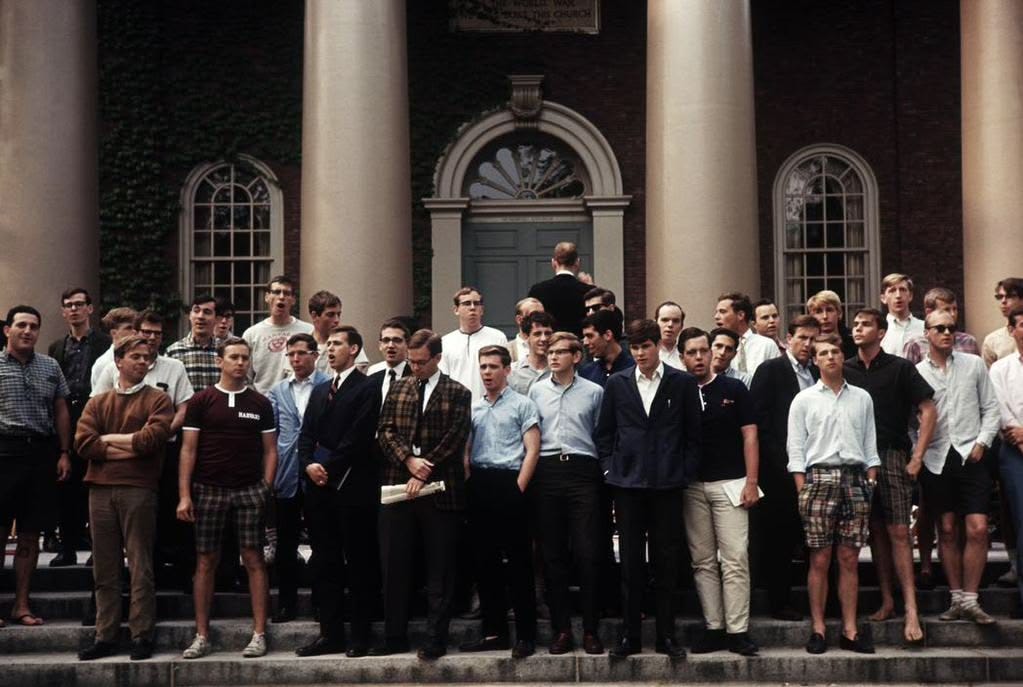
By 1897 it was in the Sears catalogue. Still, it remained a niche. Then the 1930s changed things. Wealthy American tourists began returning from exotic holidays wearing it, and Ivy League students carried it back to campus as a quiet badge of where they’d been. Demand grew slowly, then all at once.
The Mishap


In 1958, a textile importer named William Jacobson flew to Bombay with a simple brief. Find something exotic.
He found it. A vivid, hand-loomed cotton plaid from the city of Madras, soaked in vegetable dyes and sesame oil, smelling faintly of both. The man selling it, Captain C.P. Krishnan Nair of Leela Scottish Lace Ltd, was happy to oblige at one dollar a yard. He had one piece of advice: wash it gently, in cold water only. The colours will run.
Jacobson forgot to pass this on.
Ten thousand yards went to Brooks Brothers. Trousers and sport coats at fifty dollars apiece. Customers got them home, put them in the wash, and watched the colours bleed out across everything they owned.
What followed was fury, then lawyers, then a moment of luck. Rather than fight the flaw, one of Nair’s attorneys arranged an interview with the editor of Seventeen magazine. The story ran across seven pages: “Bleeding Madras — the miracle handwoven fabric from India.” Guaranteed to bleed.
Brooks Brothers was overwhelmed with orders within days.
Where to Buy Madras Today
True Bleeding Madras, hand-loomed, vegetable-dyed, guaranteed to fade, is rare in mainstream retail. Most commercial versions (Ralph Lauren, J. Crew) use chemical dyes and won’t bleed.
Here are 3 places worth knowing who still sell the real thing:
Original Madras Trading Company is, quite literally, where most of America’s best Madras has come from for the past fifty years. The company was founded in 1973 by a man who arrived in New York from Chennai with a trunk full of fabric and set up a wholesale operation in the garment district. For decades, he and his family supplied the cloth to the great American prep brands (Brooks Brothers, Ralph Lauren, J. Press) without most customers ever knowing the name behind it. Now in its third generation, run by Prasan Shah, the company makes and sells its own garments directly for the first time. Every piece is hand-loomed on traditional manual looms in Chennai, one weaver per cloth, from start to finish. No electricity. No shortcuts. Look for the turmeric-yellow selvage label, it’s their mark of the real thing.
J. Press was founded in 1902, not by a fashion house, but by a Latvian immigrant named Jacobi Press who set up a tailoring shop on Yale’s campus and became the outfitter of the Ivy League. The same campus, it’s worth noting, that Madras first arrived on 184 years earlier. J. Press didn’t invent that connection. They just never stopped honouring it. More than 120 years later, the brand is still going. They’ve been selling Madras shirts and sport coats continuously since at least 1939, and their “1902 model” Madras sport coat is still cut to the original soft-shouldered Ivy spec. If you want ready-to-wear Madras from a brand with genuine skin in the game, J. Press is the reference point.
O’Connell’s is a family-run haberdashery in Buffalo, New York, that has been open since 1959 and hasn’t really changed since. They stock classic American clothing (natural shoulder suits, seersucker, linen) and they’ve always stocked Madras. What makes them unusual is their archive. They’ve hoarded some 900 pieces of deadstock bleeding Madras dating from the 1960s to the 1990s, pieces that trickle onto the website and sell immediately. Ethan Huber, whose family has run the store for decades, puts it plainly. The old hand-loomed bleeding stuff is now all but impossible to get. O’Connell’s have it.
Beyond those three: eBay remains the best hunting ground for vintage bleeding Madras from the 1960s–80s. Search specifically for “bleeding madras” to filter out the chemical-dye versions.
Or, as Captain Nair would have suggested. Go to Chennai.